
Sources for Previous Residents of Laguna Hills
Each source covers a different era and fact. The Orange County recorder index is the strongest recent transaction trail. The assessor supplies current parcel context and may provide historical material by request. City permits begin in a new online system in 2023, with older records on a legacy path. The verified directory snapshots are 1926 and 1929 Orange County volumes that include El Toro. Census schedules are public through 1950, while Sanborn coverage for Laguna Hills was not located.
| Source | Years It Covers | Where Held | What It Shows |
|---|---|---|---|
| Recorded-document index | Online January 4, 1982-present; older indexes by book, page, and instrument | Orange County Clerk-Recorder and archives | Grantor, grantee, date, type, identifier; a copy adds legal description |
| Assessor roll or parcel card | Current annual roll; historical years by archive request | Orange County Assessor and Archives | Owner, mailing versus situs, APN, values, characteristics |
| Laguna Hills permits | New online system from January 3, 2023; earlier legacy records | Laguna Hills Building and Safety | Scope, applicant, contractor, inspections, project dates |
| City directories | 1926 and 1929 Orange County and El Toro verified; later ranges unverified | NARA, UCI, State Library, OCPL, Archives | Named adult, spouse, occupation, address, selected marks |
| Census schedules | Public through 1950 under the 72-year rule | NARA and partner library databases | Household members, relationship, occupation, tenure |
| Sanborn maps | No Laguna Hills-specific year located | Library of Congress or State Library routes | Footprint, construction, and use where mapped |
The table is a research map, not a claim that every series is complete. Older directory and map years need a volume-level or sheet-level confirmation from the repository.
Laguna Hills Previous Residents: Start With APN
Start a house history with the exact normalized address and APN. The Orange County assessor or parcel map can separate the physical situs from the tax mailing destination and provide tract, lot, legal description, property characteristics, and map context. Preserve the APN even when the street name or number changes. The APN is the bridge from today’s parcel to older deed and archive questions.
Ownership and residence are different trails. A mailing address may belong to a trust, PO box, agent, or another property. A current owner may not be the person who lived in the home. The parcel is still the right starting key because it limits the search to one piece of land before names and dates multiply.
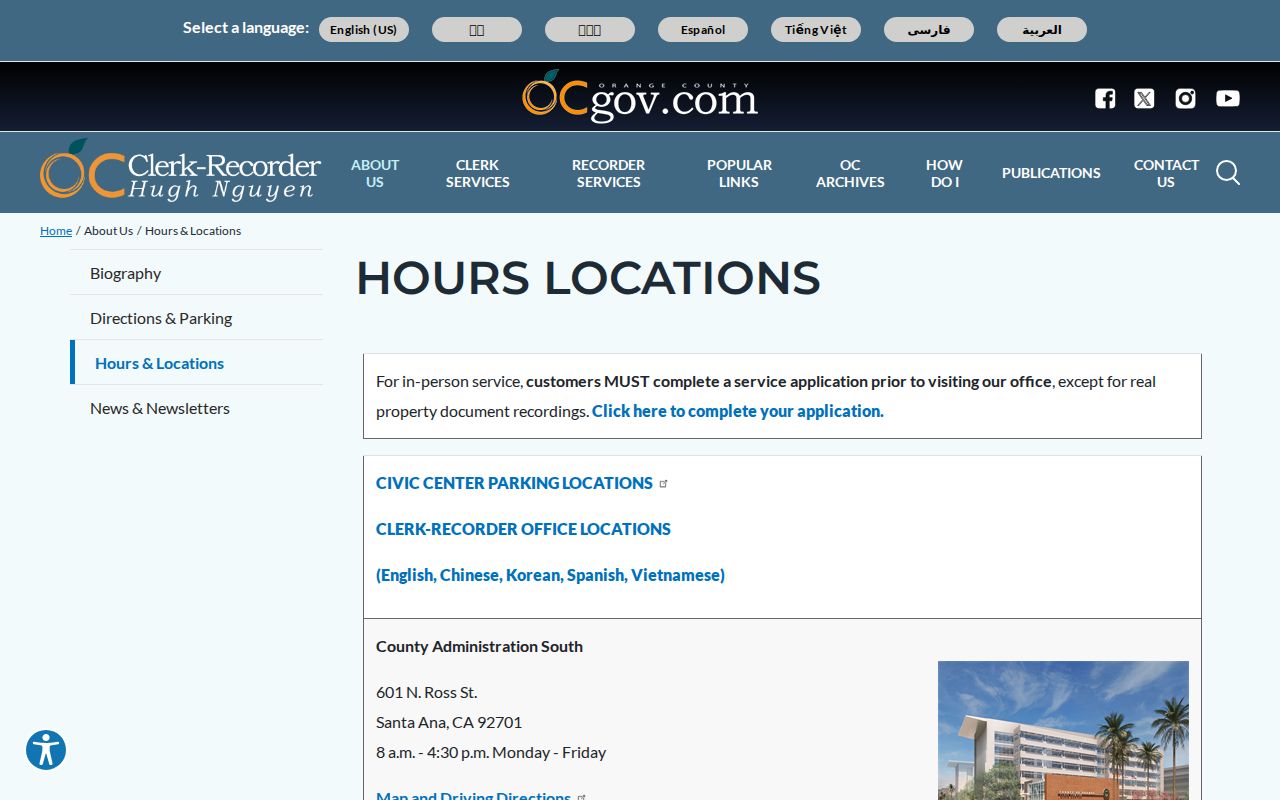
The Orange County Clerk-Recorder locations page identifies the nearby South County counter for a Laguna Hills property-record request.
Search Backward for Laguna Hills Previous Residents
After identifying the current owner, open the RecorderWorks Grantor-Grantee Index and search that person as grantee near the acquisition date. The purchase instrument should identify a seller or grantor and a legal description. Search the seller as grantee in an earlier period, then repeat. This is the deed-chain loop for previous residents and past owners.
Record each party role, recording date, document type, instrument number, and legal description. Search spelling and middle-initial variants. A grantor can sign a quitclaim or release, and a deed to a trust or entity may not show the people behind ownership. Use the legal description to reject a same-name result that belongs to another parcel.
RecorderWorks covers January 4, 1982 to the present as an online index. It does not display deed images, and county staff state that they do not perform a researcher’s name search. Once the identifier is found, request the copy through the Clerk-Recorder, by mail or at a counter.
Note: The chain of title follows recorded ownership, while a city directory or census is needed to test who lived at the address.
Laguna Hills Previous Residents: 1982 Divide
The recorder’s identifier practice changes at the online cutoff. RecorderWorks covers January 4, 1982 forward, and later instruments use a recording year plus six digits. Earlier copy requests are more efficient with book, page, and instrument information. Orange County Archives reports conserving 640 original deed volumes from 1889-1926 and conserving or digitizing 210 property-index volumes from 1889-1953.
The bridge from 1954 through January 3, 1982 is not described as a complete public online run in the research. Ask recorder or archive staff which index can be searched. The South County branch can handle current services, but older history may require Santa Ana archive guidance and a reproduction request.
A recorded copy can supply legal description, vesting, signatures, return address, notary acknowledgment, transfer-tax notation, and recording stamp, subject to redactions. Do not read a transfer-tax amount or a quitclaim as a simple statement of sale or residence.
Laguna Hills Previous Residents: Tract and Lot
Street names are the fragile part of a Laguna Hills house history. A modern road may not have existed in the agricultural or Moulton Ranch era. A pre-incorporation file may say El Toro or unincorporated Orange County. A changed house number can make a directory or census search appear empty. Use APN, tract, lot, subdivision map, historical assessor map, and legal description to bridge the labels.
City boundary dates add context. Laguna Hills incorporated December 20, 1991. North Laguna Hills annexation became effective July 1, 1996, and the Westside annexation in 2000 added residential acreage and residents. A parcel now inside the city may have earlier county records under a different administrative label. The older label is a clue, not an error.
- Grantor
- The party transferring an interest in a recorded document.
- Grantee
- The party receiving an interest in that document.
- Chain of title
- The linked sequence of recorded ownership transfers for one legal parcel.
- Legal description
- The land description that identifies the parcel beyond a street number.
Laguna Hills Previous Residents: 2023 Permits
Permit evidence can date an addition, remodel, inspection, or change in use and can name an applicant, contractor, owner authorization, project value, or inspection milestone. Laguna Hills says its Building and Safety service is 100% online for current applications, inspections, payments, and lookups. The city labels permits issued before January 3, 2023 as legacy records.
Use the current portal first, then the legacy route or a staff request if the house predates the cutover. Engineering and planning files may also carry the address, nearest cross street, APN, tract, lot, zoning, property owner, and project notice fields. A permit can explain when a structure changed, but it is not a household list and cannot prove who occupied a room.
The permit transition is useful chronology. A blank current result may mean the file is in the older system. A complete-looking permit history still reflects only work submitted to the city or its predecessor, not every change made over time.
Laguna Hills Previous Residents: El Toro
The National Archives verifies 1926 and 1929 Orange County city directories that include El Toro. Because Laguna Hills did not yet exist as a municipality, these volumes are important place-name snapshots for previous residents. The city’s official history page helps anchor the Rancho Niguel, Moulton Ranch, El Toro, and incorporation sequence. Search the surname section, copy the entry exactly, and inspect any street or reverse section. An entry may show a named adult, spouse, address, occupation, telephone, or ownership mark, but it does not list every resident.
Later collection evidence is less exact. UCI’s finding aid identifies an Orange County series dated 1950-1990 at collection level. Orange County Archives lists directories and newspapers without publishing a complete run. OCPL and California State Library reference routes may locate telephone books or genealogy databases. Ask for the actual volume rather than assuming a date span means every year is present.
The Laguna Hills city directory collections page explains how to read and pair these sources. The previous-residents task keeps the question on one address and uses the directory as one dated layer in that history.
Laguna Hills Previous Residents: Census and Probate
Directory years fall between census decades, so the two sources work best together. The 1950 census is the latest released population schedule under the seventy-two-year rule. Laguna Hills-area households may be filed under El Toro, unincorporated county territory, or a historical enumeration district. Use NARA descriptions and maps to locate the correct district before browsing surnames.
- Copy the directory name, spouse, address, and place label exactly.
- Check the matching census decade and enumeration district for household members and relationships.
- Use deeds and assessor material to test ownership and the parcel description.
- Search probate when an owner’s death may explain a transfer, representative, or heir.
- Use an obituary or newspaper notice as a lead, then verify the death or estate in an official record.
Probate can identify decedents, petitioners, nominated representatives, heirs, and counsel. Addresses and attachments may be redacted. A trust deed may obscure a family relationship, while a quitclaim may simply release an interest. The endpoint should be described as a supported conclusion, not a story filled in from assumption.
Where Laguna Hills Previous Residents Research Ends
No verified Laguna Hills-specific Sanborn sheet was located, and the research did not establish a local house-history guide or a complete reverse-directory run. The area’s suburban build-out may postdate classic Sanborn coverage. Those gaps are useful findings because they tell a researcher to use tract maps, permits, deeds, census schedules, directories, newspapers, and archives instead of manufacturing a map or year.
Other endpoints are lawful boundaries. Safe at Home addresses, confidential voters, sealed adoption material, juvenile files, DMV information, and private household details will not become public through a more persistent search. An absent name can mean protection, a move, a coverage gap, or a different place label. It does not prove that the person never lived at the parcel.
House-history use. Use previous residents research for genealogy, stewardship, family history, and understanding a property’s past. Do not turn a deed chain or old directory entry into stalking, harassment, intimidation, or harm.
A good closing note lists the last verified source, its date and identifier, the next custodian to contact, and the fact that remains unproved. That is the difference between a careful past-residents trail and a guessed household story.