
Laguna Hills City Directory Collections
The known historical shelf is a set of partial, differently described collections. The National Archives gives the clearest exact local clue by listing 1926 and 1929 Orange County directories that include El Toro. A UCI finding aid identifies an Orange County directory series dated 1950-1990, but it does not prove that every year includes Laguna Hills. Orange County Archives lists county directories and newspapers without publishing a complete run. California State Library and OC Public Libraries provide catalog and database routes rather than a confirmed branch-by-branch year list.
| Collection | Years | Where Held | Access |
|---|---|---|---|
| Orange County directories including El Toro | 1926 and 1929 verified | National Archives directory listing and research access | Check the volume and reproduction route |
| Orange County directory series | 1950-1990 collection-level range | UCI Special Collections, Box 3 finding aid | Contact in advance; year-by-year coverage unverified |
| Orange County directories and newspapers | Exact run not published | Orange County Archives | Call or email; catalog access is unreliable |
| California city-directory database | Exact Laguna Hills and El Toro years not published | California State Library | Search the catalog or request reference help |
| Telephone books and genealogy databases | Local years not published | State Library and OCPL | Library card, in-library terminal, or staff route may apply |
This table is deliberately cautious. No official source reviewed supplies an exhaustive Laguna Hills publisher-and-year run, a verified digitized local criss-cross run, or a branch-level obituary index. A careful request names the place variant and asks staff to inspect the actual catalog record.
Laguna Hills Before the Name
Laguna Hills incorporated on December 20, 1991, but its directory history belongs to an older landscape. Rancho Niguel, Moulton Ranch, El Toro, and unincorporated Orange County can all be relevant search terms. A period publisher followed the community or postal identity available at the time. A modern city directory query that uses only Laguna Hills risks missing the people and addresses recorded before incorporation.
Orange County’s historical land trail begins after the county was created from Los Angeles County in 1889, while earlier Spanish and Mexican land-grant material follows a different archive path. The city’s official history describes ranch leasing and purchase, later subdivision, and the development that produced modern tracts. Those facts explain why tract, lot, APN, and legal description can be more reliable than a current street name when a household is traced backward.
The place-name question should be written into research notes. Record the modern label, the historical community name, the county, and the nearby directory communities that may have shared coverage. This is a geography problem, not a reason to invent a directory year.
Laguna Hills 1926 and 1929 Directory Volumes
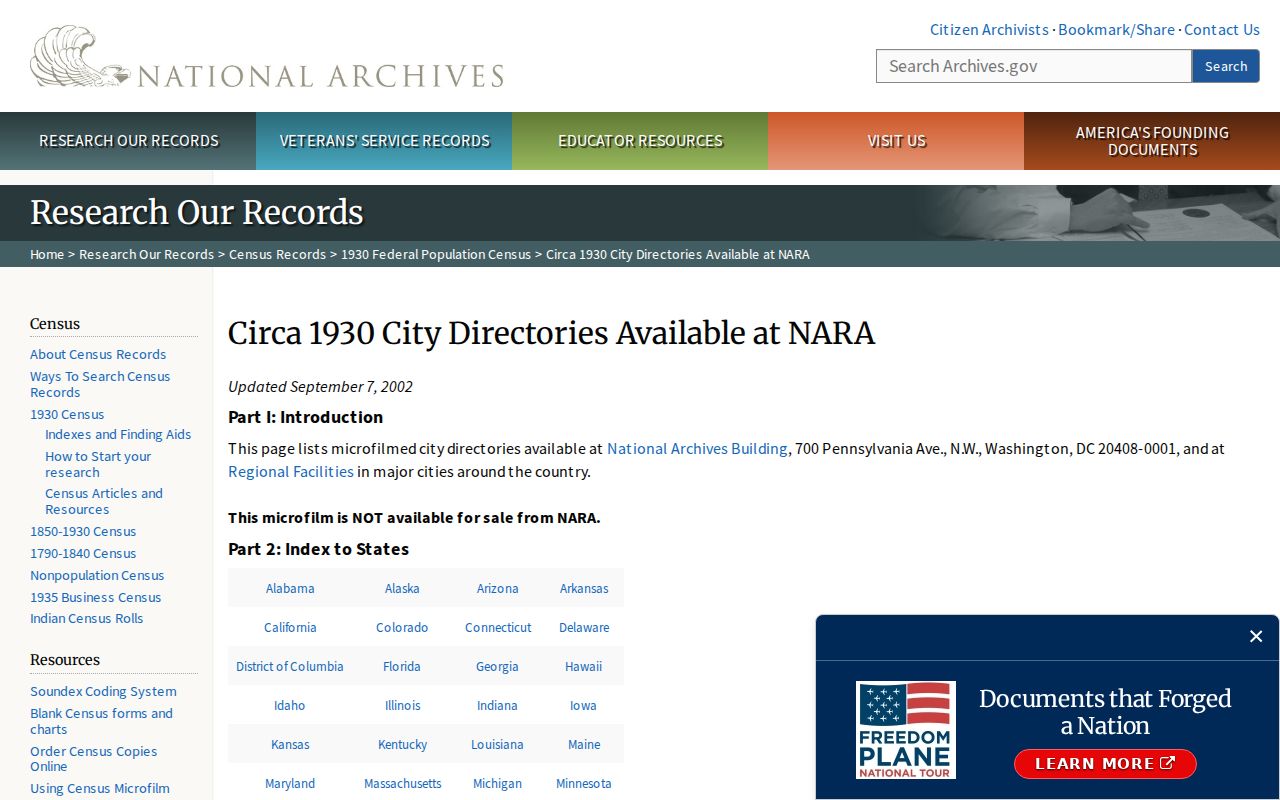
The National Archives directory page verifies Orange County directories for 1926 and 1929 and explicitly lists El Toro. These are the strongest published exact years located for the Laguna Hills area. They offer a named-resident snapshot decades before the present municipality, but the volume itself must be inspected for its publisher, abbreviation key, street section, and exact community coverage.
A city directory entry is not a census form. It may select a head of household or a working adult, show a spouse in parentheses, and use shorthand for residence or workplace. It may omit children, lodgers, a person who declined listing, or a household in a coverage gap. Use the entry to form a dated lead, then pair it with the 1930 census or a deed, obituary, or probate file.
The National Archives Orange County directory resource is the published source for the 1926 and 1929 El Toro references.
Laguna Hills Library and Directory Databases
The Laguna Hills Library is the practical local access point for public computers, the OCPL catalog, newspapers, telephone books, and licensed genealogy tools. Its listed hours are Monday-Thursday, 10 a.m.-7 p.m., and Saturday, 9 a.m.-5 p.m.; the branch is closed Friday and Sunday. OCPL resources include Ancestry Library Edition, HeritageQuest, family and local histories, census maps, genealogy referrals, and obituary-search guidance.
The branch does not publish an exhaustive city-directory holdings page. Ask staff to search the catalog for Laguna Hills, El Toro, Orange County, Mission Viejo, Laguna Beach, San Juan Capistrano, and telephone-book variants. Access may differ between a library terminal and a home login. A staff reference question can also be sent toward the California State Library when the local catalog does not disclose a run.
The OCPL genealogy gateway identifies the library databases and obituary-search routes that support a city directory search.
Reading a Laguna Hills City Directory Entry
No digitized Laguna Hills-specific sample page was available for inspection in the official sources reviewed. The safe method is to describe the common entry fields and then read the actual volume’s key before decoding them. A historical city directory is a publisher’s snapshot, not a complete resident roll.
| Name | Surname and given name or initials; a spouse may appear in parentheses. |
|---|---|
| Occupation | Work description or employer where the volume supplies one; terminology varies by year. |
| Residence | House number and street, often marked with a residence abbreviation. |
| Workplace | A separate business or office address may appear beside the home entry. |
| Owner or renter mark | Some volumes use symbols or letters; confirm them in the local key. |
| Widow or cross-reference note | A family clue or a pointer to another name can explain a change in listing. |
- Criss-cross section
- The street-order part of a directory. It lets a researcher move from a house number to a named entry when that section exists.
- Householder index
- A name or address aid used to locate a household in a larger collection. It is not necessarily an index of every person.
- Abbreviation key
- The volume’s decoding guide. Photograph or transcribe it before treating a mark as a relationship, residence, or ownership fact.
Spelling matters. Test initials, diacritics, surname order, OCR variants, spouse names, and nearby addresses. A missing surname may be a scan problem, a publisher choice, or a move.
UCI’s Laguna Hills 1950-1990 Directory Series
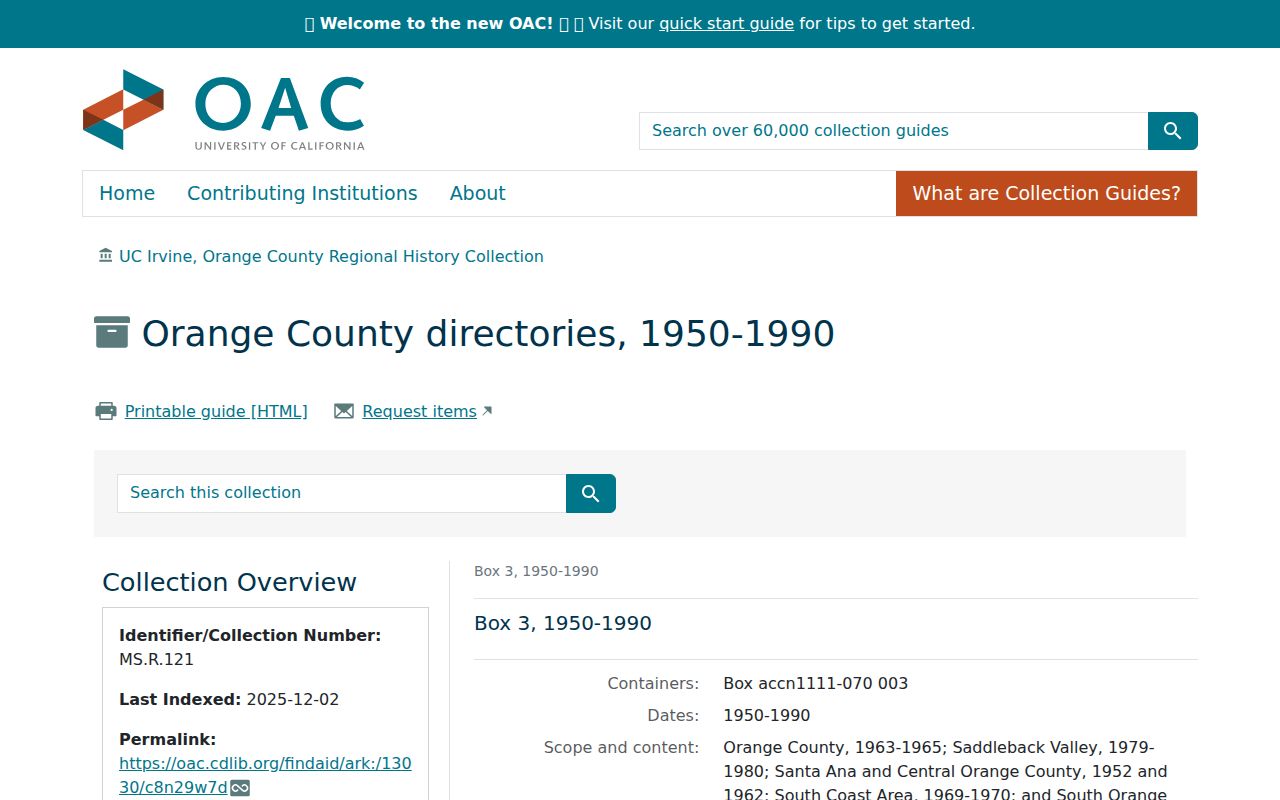
The UCI Special Collections finding aid identifies a Box 3 Orange County directory series dated 1950-1990. That range is collection-level information. It does not establish that every publication year is present, that every volume includes El Toro or Laguna Hills, or that a digitized page can be viewed online. Contact the repository before relying on a date.
This series is valuable because it may cover the transition from county and ranch references into suburban tract development. Pair any entry with the street’s APN, tract, or lot where possible. A changed number can make a surname search look like a disappearance, while a legal description can connect the old and new locations.
The UCI Orange County directory finding aid is the source for the 1950-1990 collection-level range.
Laguna Hills Archives: Historical Directory Shelf
Orange County Archives lists historic county records, directories, newspapers, property material, and vital collections. The public page says much of the material predates 1960, while the online catalog did not reliably expose a complete inventory during research. The archives are therefore a contact-and-reference stop, not a promise of an open shelf or a specific Laguna Hills volume.
California State Archives adds county naturalization material dated 1889-1944 and homestead records dated 1889-1926, plus broader executive, legislative, judicial, land-grant, military, and government collections. Those materials can explain a person or parcel’s historical setting, but Orange County Archives and the Clerk-Recorder remain better first stops for parcel-specific deeds.
The Orange County Archives holdings page is the appropriate contact route for historic directories and newspaper material.
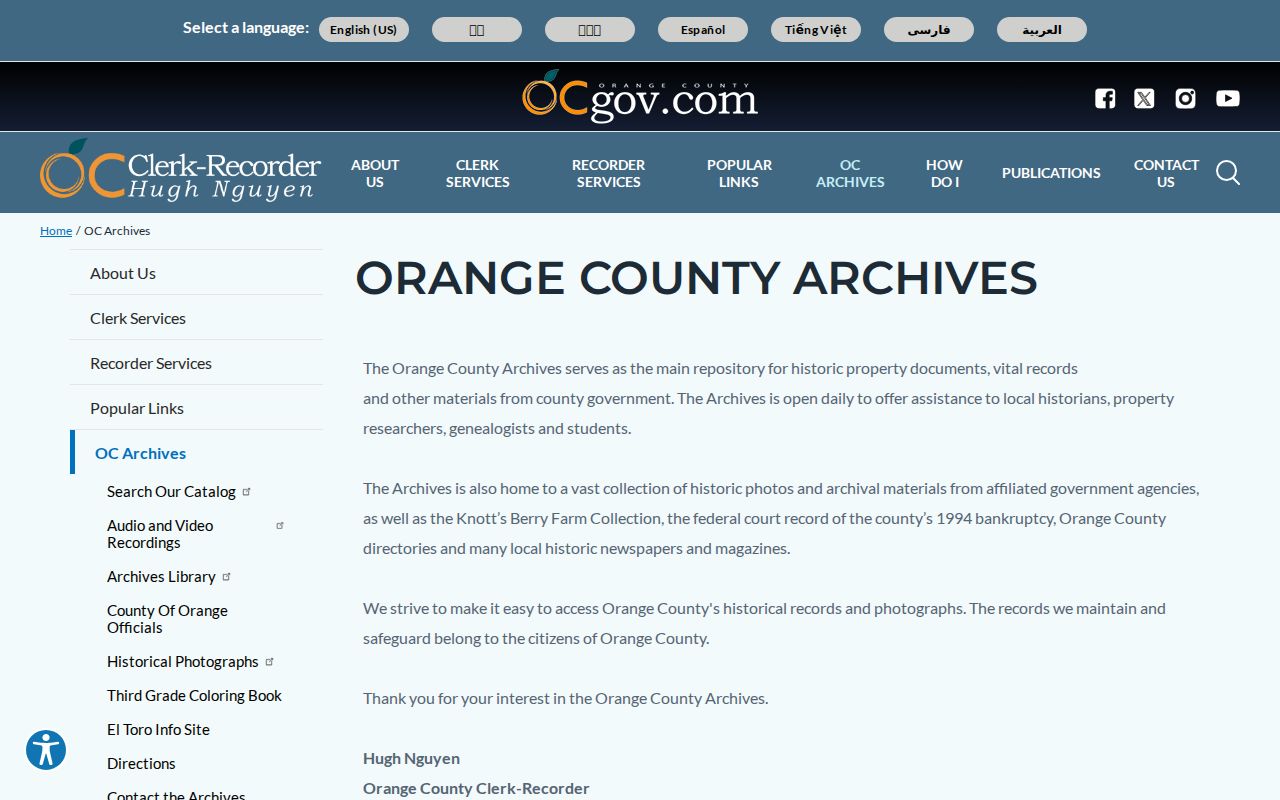
Use the county archive contact as a confirmation step, then keep the directory’s repository, date range, and access condition in the research note.
The California State Archives provides a broader government-record research route when county material points to a state collection.
Trace a Laguna Hills Directory Household
A city directory is most useful when it becomes a dated sequence. Start with the best place-name and one likely spelling, then preserve the exact entry rather than paraphrasing it. Follow the address and household clues forward and backward, while testing the gaps against a census or county record.
- Establish whether the volume uses Laguna Hills, El Toro, Orange County, or another postal community.
- Search the alphabetical section and copy the name, spouse, occupation, address, symbols, and cross-reference exactly.
- Check a street or reverse section when present, then note nearby addresses without treating them as a complete block roster.
- Move one publication year at a time and mark first appearance, move, changed name, widow notation, and disappearance.
- Pair directory hits with the 1920, 1930, 1940, or 1950 census, then use deeds, probate, or an obituary to resolve ownership or death.
The 1950 census is the latest publicly released population schedule under the seventy-two-year rule; 1960 is due in 2032. Laguna Hills-area households may be enumerated under county or El Toro geography, so an enumeration district map matters more than a modern municipal boundary.
Note: A directory disappearance can mean a move, death, an unlisted adult, an absent volume, or a change in publisher coverage.
When a Laguna Hills Directory Entry Disappears
Blank years and missing names are common research conditions in a Laguna Hills city directory. The local evidence has explicit gaps: no exhaustive publisher run, no verified local digitized criss-cross series, and no branch-level obituary index were located. The correct response is a reference request, not a guessed year. Ask a library or archive to check the catalog, then compare the result with APN, tract, deed, probate, newspaper, and census clues.
Historical directories also selected their audience. An adult may be left out, a spouse may be listed only in parentheses, and a household may fall outside the publisher’s geographic coverage. A later city directory can use a different place name or street order. Even an entry with an address is a historical lead, not a current residence finding.
Research boundary. The verified local anchor is the 1926 and 1929 Orange County coverage that names El Toro. Later collection ranges require volume-by-volume confirmation.
Use the Laguna Hills resident lookup when a historical entry needs modern identity corroboration. Keep the city directory focused on the collection, its years, its shelf, and the way an entry should be read.